
Business
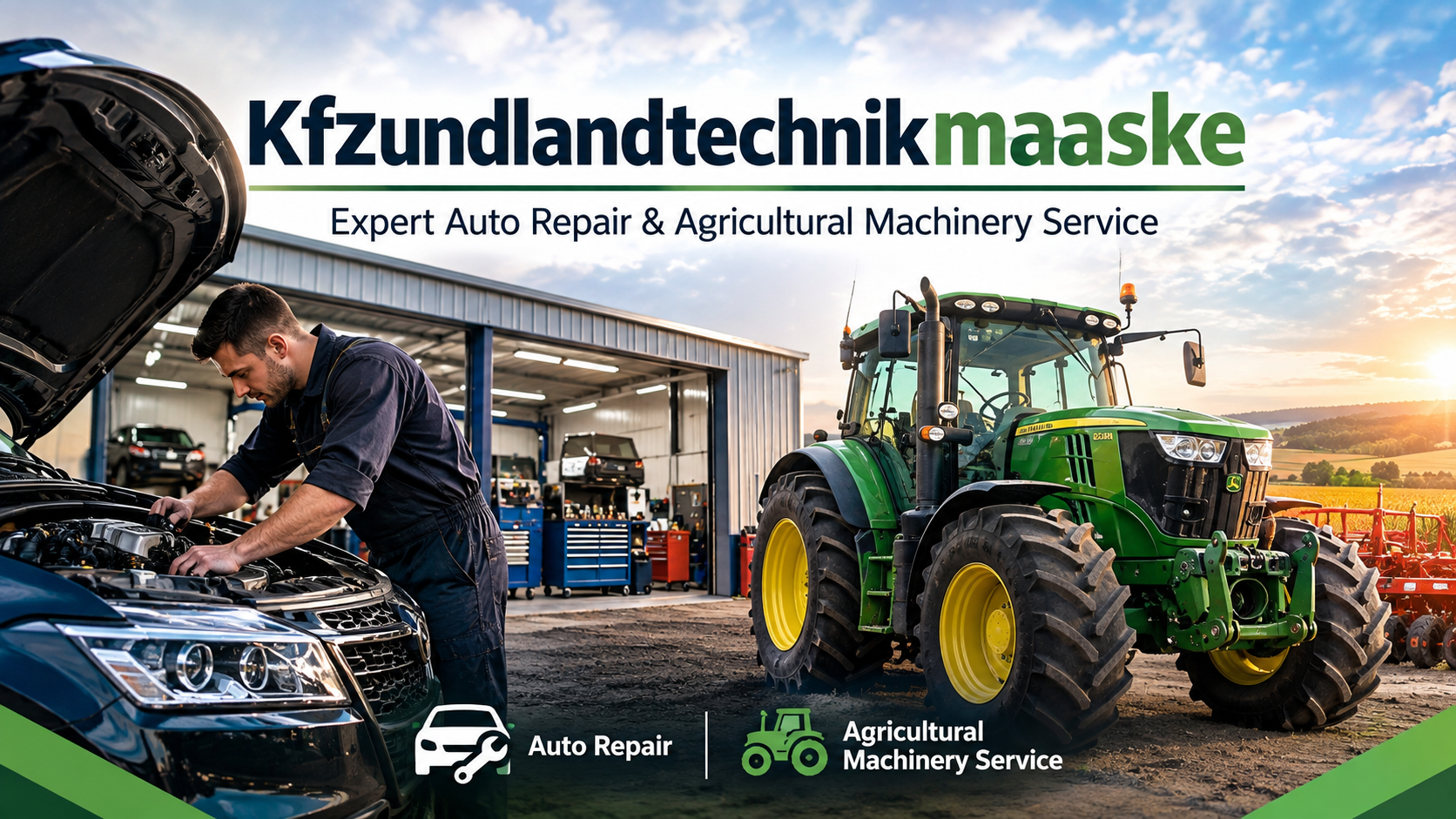
Kfzundlandtechnikmaaske: Expert Auto Repair & Agricultural Machinery Service

Kfzundlandtechnikmaaske is a distinctive business name associated with the automotive and agricultural machinery sectors in Germany. The term brings together two practical areas that are especially important in rural communities: motor vehicle service and agricultural technology. For people searching this name online, the main intent is usually to understand what the business was known for, where it was located, what kind of work it handled, and how its automotive and agricultural focus came together.
The name itself provides an important clue about the company’s identity. “KFZ” is commonly used in Germany as an abbreviation for Kraftfahrzeug, meaning motor vehicle, while “Landtechnik” refers broadly to agricultural machinery and technology. Public business directories have associated Kfzundlandtechnikmaaske with Schmiedeberg 2A in Gudow, Schleswig-Holstein, and historical online references connect the name with the Kehrsen area. Because online business records can become outdated, current availability and operating status should be checked before anyone relies on older contact information.
What Kfzundlandtechnikmaaske Represents
Kfzundlandtechnikmaaske stands out because it combines automotive work with agricultural machinery rather than concentrating on only one mechanical field. That combination makes sense in areas where private vehicles, work vehicles, tractors, and farming equipment are all part of everyday life. A business serving this environment needs an understanding of practical mechanical systems and the different demands placed on road vehicles and agricultural equipment.
The automotive side of the business identity relates to motor vehicles and workshop activity, while the agricultural side points toward tractors, farm machinery, implements, and related equipment. These two sectors have different operating environments, but they also share fundamental systems such as engines, transmissions, brakes, steering, electrical components, batteries, tires, and hydraulic technology. This overlap helps explain why a combined automotive and agricultural workshop can be useful to rural customers.
Automotive Services Associated With Kfzundlandtechnikmaaske
The KFZ portion of the name naturally connects the business with vehicle maintenance and repair. Automotive workshop work can cover routine servicing as well as troubleshooting mechanical problems that affect safety, reliability, and daily transportation. Regular maintenance is particularly important because small problems involving brakes, fluids, batteries, tires, belts, or electrical components can become more expensive when they are ignored.
For vehicle owners, the value of a professional workshop is not simply the ability to replace a damaged component. Good repair work begins with identifying the underlying problem, selecting an appropriate repair approach, and making sure the vehicle is returned to dependable operating condition. Modern vehicles also require increasing attention to electronic systems and diagnostic equipment, meaning mechanical experience and technical knowledge often need to work together.
Agricultural Machinery and Landtechnik Services
The Landtechnik part of Kfzundlandtechnikmaaske is equally important because agricultural machinery operates under demanding conditions. Tractors and farm equipment can spend long hours working in dust, mud, moisture, heat, and heavy loads. Regular servicing is therefore an important part of keeping machinery productive and reducing the risk of unexpected downtime during busy periods.
Agricultural machinery also differs significantly from ordinary passenger vehicles. A tractor may use specialized hydraulics, power take-off systems, heavy-duty transmissions, agricultural tires, implements, and electronic controls. Repairs can require knowledge of how several systems work together. For farmers and agricultural operators, reliable machinery is directly connected with productivity, making professional inspection and timely maintenance especially valuable.
Why the Combined Automotive and Agricultural Focus Matters
The combined identity of Kfzundlandtechnikmaaske is significant because automotive and agricultural customers can have overlapping mechanical needs. A rural business owner might depend on a passenger vehicle or commercial vehicle for transportation while also operating tractors and other machinery. Having a service provider familiar with both environments can make the search for technical assistance more straightforward.
There is also a practical relationship between road transport and farming. Agricultural businesses frequently move machinery, materials, tools, and products between fields, farms, storage facilities, and roads. This creates a need for dependable vehicles as well as dependable agricultural equipment. A workshop associated with both KFZ and Landtechnik therefore reflects the interconnected nature of mechanical work in rural regions.
Kfzundlandtechnikmaaske and Its Gudow Connection
Online business directories associate Kfzundlandtechnikmaaske with Schmiedeberg 2A, 23899 Gudow, in Schleswig-Holstein. One directory lists weekday opening hours from morning through late afternoon and provides a telephone number and email address, while another directory currently states that the company has been reported as closed. These conflicting records are important because they show why older directory information should not automatically be treated as confirmation of present-day operations.
Historical references also connect the business name with Kehrsen and the surrounding Mecklenburg and Schleswig-Holstein region. A 2018 discussion on a Zetor-focused forum identifies KFZ und Landtechnik Maaske as a Zetor dealer or workshop in Kehrsen and describes a tractor maintenance experience. That forum entry is useful as historical context, but it should not be interpreted as proof of the company’s current services, ownership, or operating status.
The Importance of Vehicle Repair Expertise
Vehicle repair requires more than replacing parts whenever something stops working. A reliable diagnostic process helps determine whether a symptom is caused by a single component or by a wider mechanical or electrical problem. This is especially relevant with modern vehicles, where electronic control units and sensors can influence engine performance, braking systems, emissions, comfort functions, and other areas.
Preventive maintenance also has an important role. Oil and filter servicing, brake checks, tire inspections, battery testing, fluid checks, and attention to warning signs can help owners identify problems before they become serious. The exact maintenance schedule depends on the vehicle, its age, mileage, manufacturer requirements, and how it is used, so professional advice should be based on the specific vehicle rather than a one-size-fits-all approach.
The Importance of Agricultural Machinery Maintenance
Agricultural machinery often works under far more demanding conditions than ordinary vehicles. Tractors and other machines may operate for long periods while pulling heavy loads or powering attached equipment. Components such as hydraulic systems, cooling systems, transmissions, bearings, belts, electrical systems, and tires can therefore experience significant stress.
Maintenance is particularly important during agricultural seasons when equipment needs to be available with minimal interruption. A mechanical problem at the wrong time can delay fieldwork and create additional costs. Regular inspections and appropriate servicing can help identify worn components earlier. For older machinery, maintenance can also be an important way to extend useful service life when replacement with new equipment is not practical.
Modern Diagnostics in Automotive and Agricultural Repair
Mechanical service has changed considerably as vehicles and agricultural machinery have become more sophisticated. Modern machines can contain electronic control units, sensors, digital displays, electronically controlled systems, and specialized diagnostic interfaces. Technicians increasingly need to understand both traditional mechanical principles and modern electronic systems.
This does not mean that basic mechanical expertise has become less important. Instead, modern diagnostics often work best when electronic information is combined with physical inspection and practical mechanical knowledge. A diagnostic code may indicate where a system has detected an abnormal condition, but determining the real cause can still require careful testing. This is particularly important when a sensor problem is actually the result of wiring, mechanical wear, contamination, or another underlying issue.
What Customers Should Look For in a Workshop
When researching a workshop such as Kfzundlandtechnikmaaske, customers should first establish whether the business is currently operating and whether the services they need are actually available. This is particularly important when search results contain older directories, historical forum discussions, or pages that have not been updated recently. A listed address or telephone number is not necessarily proof that the same business continues to operate there today.
Customers should also look for clear information about the type of vehicle or machinery supported, appointment arrangements, repair estimates, warranty terms, and parts availability. For specialized agricultural machinery, it can be especially useful to confirm whether the workshop has experience with the particular tractor, implement, or machinery system involved. These checks can prevent misunderstandings and help customers choose an appropriate service provider for their specific requirements.
Understanding the Online Information Around Kfzundlandtechnikmaaske
Search results for Kfzundlandtechnikmaaske currently contain a mixture of historical business information and newer websites using the name as a search topic. The original business identity should therefore be distinguished from unrelated or recently created websites that publish general automotive articles. A website using the same keyword does not automatically establish a connection with the original workshop.
This distinction matters for anyone researching the business. A recently registered domain using a familiar business name may provide information about the keyword without being the company’s established official website. Similarly, third-party directories can preserve old addresses and opening hours even after a business changes status. Comparing multiple sources and checking the most recent available information is therefore a sensible approach.
Why Local Mechanical Businesses Remain Important
Local workshops continue to play an important role because vehicles and machinery cannot always be transported long distances for every repair. A nearby specialist can provide practical support while reducing the logistical burden associated with moving heavy agricultural equipment. This is especially relevant for tractors and machinery that may not be designed for ordinary road travel or may be difficult to transport without specialized arrangements.
Local knowledge can also be valuable. Agricultural operators understand that machinery problems can affect schedules, weather-dependent work, and seasonal deadlines. Automotive customers have their own transportation requirements and may depend on a vehicle for commuting or business activity. A service business familiar with the local environment can therefore become an important part of the wider rural economy.
Kfzundlandtechnikmaaske as a Search Term
The exact-match keyword Kfzundlandtechnikmaaske is highly specific, which means people searching it are likely looking for information about the business rather than broad advice about cars or tractors. Their questions may involve the company’s identity, historical location, services, contact information, agricultural machinery connection, or current status. A useful article therefore needs to answer these questions without confusing historical records with confirmed present-day facts.
The unusual spelling also makes the term important from an SEO perspective. Users who remember the business name may enter the complete phrase into a search engine rather than using general terms such as “car repair” or “tractor service.” Clear coverage of the business name, its automotive connection, its Landtechnik identity, and its historical context can make information easier to understand for people who arrive through exact-name searches.
Final Thoughts
Kfzundlandtechnikmaaske represents a business identity built around two closely connected areas: automotive service and agricultural machinery. The KFZ element points toward motor vehicles, while Landtechnik reflects tractors, agricultural equipment, and specialist machinery. Historical online sources associate the business with the Gudow and Kehrsen area of Schleswig-Holstein, while current directory information is inconsistent about whether the original operation remains active.
For anyone researching the company, the most important point is to distinguish reliable historical information from current operating details. Public directories can preserve useful information about an older business, but addresses, opening hours, contact details, and service availability can change. The safest approach is to verify current information directly before planning a visit, requesting a repair, or relying on a listed contact method.
Kfzundlandtechnikmaaske remains an interesting search term because it reflects the practical connection between road vehicles and agricultural machinery. Whether someone encounters the name while researching vehicle repairs, tractor service, or an older local business record, understanding both sides of the name provides useful context. Its combined automotive and agricultural identity explains why the business name can appear across two different but closely related areas of mechanical service.
Conclusion
Kfzundlandtechnikmaaske is best understood as the name associated with an automotive and agricultural machinery business in the Gudow and Kehrsen area of Schleswig-Holstein. Its identity connects KFZ services with Landtechnik, creating a business profile that relates to both motor vehicles and agricultural equipment. Historical sources provide evidence of that connection, while current online records should be treated carefully because they do not all agree about the business’s present status.
For customers researching the name today, accurate verification is more important than relying on a single directory page. The automotive and agricultural sectors both depend on skilled maintenance, proper diagnosis, and dependable mechanical support, but the exact services offered by a particular workshop must always be confirmed. By separating historical context from current information, readers can develop a clearer and more reliable understanding of Kfzundlandtechnikmaaske.

Idaho communities can look to federal grants for support with projects that improve public services, strengthen rural areas, and expand opportunity for residents. Eligible work can include workforce training, health access, community facilities, conservation, housing, transportation planning, education, public safety, and economic development. The most useful federal opportunity is not always the largest award. It is the one that fits the applicant’s legal eligibility, the community need, and the organization’s ability to complete the work and meet reporting requirements.
Understanding Federal Support in Idaho
Distance can be a central consideration for Idaho projects. A program serving a small town, agricultural area, tribal community, or remote county may need to address travel, communications, staffing, or participant access differently than a program based in a larger city. The proposal should identify these factors early, because they affect project design and cost. A generic service model is less convincing than an approach that shows how residents will learn about the program, participate in it, and receive follow-up support.
Funding Projects From Planning Through Delivery
Federal funding can help applicants move a project through distinct phases. A community development effort may begin with a needs assessment, planning process, engineering work, or public engagement. Once the project is active, funding may support program staff, equipment, materials, training, technical assistance, facility improvements, or data collection. Applicants should distinguish between what is needed now and what will be sustained later. That separation makes it easier to explain the grant request and to avoid promising costs that the organization cannot continue after the award ends.
Starting With the Right Applicant and Partnership
Idaho nonprofits, local governments, schools, extension services, employers, and public agencies can work together when their roles are clear. A nonprofit may deliver outreach and participant support, while a public partner provides oversight or a required match. A college or employer may contribute instruction or labor-market knowledge. These arrangements should be developed around practical delivery. Each partner should understand timelines, recordkeeping duties, and who will resolve issues if the scope of work changes.
When reviewing possible grants, Idaho applicants should look beyond a program title. They should read the eligibility rules, geographic scope, matching requirements, allowable costs, application timing, and reporting obligations. A project that sounds promising may not fit if the organization cannot meet a required match, operate on the expected schedule, or document intended outcomes. A modest program that closely matches the federal purpose is often stronger than a larger proposal that tries to cover too many unrelated activities.
Creating a Practical Idaho Grant Strategy
A workforce project might monitor training completion, employer engagement, or participant referrals. A community-facility effort could track use of improved space, services offered, or residents reached. A conservation project may record plans completed, technical assistance delivered, or landowners participating. Choosing a small number of useful measures helps staff manage the project and gives funders a clear view of progress.
Community communication should be part of the delivery plan, not an afterthought. Residents and potential participants need to know who the project serves, what assistance or activity is offered, whether there are eligibility steps, and how to ask questions. Plain language, accessible materials, and trusted referral partners can improve participation. Idaho applicants should also create a way to hear from participants during implementation, so the organization can identify barriers early and make reasonable adjustments while staying within the approved project scope. Program staff should document recurring questions and use them to improve outreach, participant materials, and follow-up without changing the approved purpose of the grant.
A careful budget gives the project its operational backbone. In Idaho, applicants should identify the staff time, materials, equipment, contracted expertise, outreach, and evaluation activities that are genuinely needed for delivery. If a cost will be shared by a partner or covered after the award period, that role should be stated clearly. This helps reviewers see that the proposed grant amount is connected to a manageable scope of work, rather than an estimate built around general organizational needs.
Organizations should also be candid about what they can sustain. Federal funding can launch or expand a service, but it may not support every future expense. A practical application explains how the organization will preserve useful partnerships, maintain equipment, continue referrals, or seek later support when the project period concludes. This does not require a promise of permanent funding. It shows that leaders have considered how the work will remain responsible once the original award is complete.
A thoughtful review of grants for nonprofits funding also helps leaders assess compliance before applying. Federal awards can require financial controls, procurement practices, progress reports, record retention, and careful handling of participant information. The organization should decide in advance who will manage these responsibilities and how documentation will be retained. Clear agreements and practical reporting systems can prevent administrative problems from becoming obstacles to the community work the funding was intended to support.
Idaho applicants can use federal grants to support projects that are responsive to place, access, and long-term capacity. The strongest proposals explain the local need, select realistic activities, build partnerships that can deliver, and connect every use of funds to a measurable public benefit.

Money you’ve earned but haven’t collected can’t pay salaries, vendors or growth plans. That’s why the order-to-cash (O2C) cycle deserves as much attention as sales itself. Small delays at each stage slow cash flow and increase finance’s workload.
This guide covers what O2C involves, where it breaks, and ten practices to fix it.
What Is Order-to-Cash?
Order-to-cash is the process that runs from the moment a customer places an order until the company receives and reconciles payment. It also forms part of the wider quote-to-cash process.
Key O2C Stages
A common view breaks the cycle into five stages:
- Order management: Capture and validate the order.
- Fulfilment: Deliver the goods or services.
- Invoicing: Bill accurately and on time.
- Collections: Follow up on unpaid invoices.
- Reconciliation: Match payments to invoices and report.
Some guides expand these into eight or ten steps, adding credit management, payment processing and reporting. The core flow stays the same.
Why O2C Optimisation Matters
A slow cycle ties up cash in receivables. Days sales outstanding (DSO) measures that delay and is usually calculated as accounts receivable divided by credit sales, multiplied by the number of days in the period. A high DSO limits liquidity, while a lower DSO indicates efficient credit and collections management.
Working capital, billing accuracy, and customer experience are all connected. Errors that delay an invoice also delay payment, while confusing bills can frustrate customers who would otherwise pay on time. Order to cash software helps streamline the entire process by automating reminders, dispute handling, and cash application, reducing DSO and improving working capital.
Here’s a point worth remembering: DSO problems often begin before an invoice exists.
Common O2C Challenges
Four problems slow many O2C cycles:
- Manual entry: Re-keying data across systems invites mistakes.
- Invoice errors: Wrong prices, taxes or terms trigger rework.
- Disputes: They slow payment and push DSO up.
- Delayed payments: Unclear terms and limited payment options hold up cash.
Each problem feeds the next. A manual entry error becomes an invoice error, which becomes a dispute, which becomes a delayed payment. Fixing one link only goes so far if the rest of the chain stays unchanged.
10 O2C Best Practices
1. Standardise Order Data
Keep customer, pricing and contract records consistent from the first touchpoint. When sales, finance and operations each hold a different version, errors travel downstream. A single source for these records removes a common cause of errors. Standard fields for customer names, tax details and payment terms make later matching far easier.
2. Automate Billing
Reduce manual work and issue invoices promptly. Every day between delivery and invoice is a day added to your cash cycle. Automation triggers invoices from contract terms or usage instead of waiting for someone to prepare them.
3. Improve Invoice Accuracy
Validate charges, taxes, terms and purchase order details before an invoice goes out. Catching a wrong PO number before sending is far cheaper than fixing it after the customer rejects the invoice. Matching invoice details to the purchase order also reduces the chance of a customer rejecting the bill. How often do your invoices come back?
4. Connect Business Systems
Integrate CRM, CPQ, billing, ERP and accounting tools so data moves once instead of requiring retyping. Order accuracy improves, and finance stops chasing sales for missing details. Imagine closing a quarter without a single request to confirm a customer’s billing address.
5. Simplify Payments
Clarify payment terms on every quote and invoice, and offer payment methods that suit your customers.
6. Improve Collections
Send reminders before and after the due date, and prioritise overdue accounts by size and risk. Zenskar’s collections module, For instance, offers invoice payment reminders, customer segments by payment status and aging, and identification of at-risk customers. Steady follow-up usually works better than occasional bursts of chasing.
7. Resolve Disputes Quickly
Track every dispute, assign an owner and look for patterns. If the same invoice problem keeps appearing, fix its cause at the source instead of resolving it one ticket at a time. Disputes slow payment, so speed matters. A short feedback loop between collections, billing and sales helps here.
8. Automate Cash Application
Match incoming payments to open invoices automatically and flag exceptions for review. Unapplied cash is money received but not yet matched, and it can distort customer balances until someone clears it. Accurate matching also keeps collectors from chasing invoices that have already been paid.
9. Track O2C KPIs
Monitor DSO, overdue invoices, disputes and unapplied cash on a regular schedule. Consistent tracking shows whether changes help or just move the problem elsewhere.
10. Improve Continuously
Review bottlenecks each quarter and measure whether each fix worked. Treat order to cash as a process you tune, not a project you finish. Small, steady gains often compound over time.
Measuring O2C Performance
Common choices include:
- DSO: Average days to collect payment after a sale.
- Best possible DSO: The DSO you’d see if no invoice were overdue.
- Order-to-cash cycle time: Total time from order to cash.
- Days between delivery and billing: A direct view of invoicing delays.
- Average days unapplied cash: How long payments wait to be matched.
- Cash application match rate: Share of payments matched automatically.
Review them together, because one number rarely tells the full story. Context matters too. If your best possible DSO is 30 days and the actual DSO is 32, collections are in good shape. At 50, the collections process needs attention.
Technology for O2C
Automation and integration reduce the manual touchpoints that cause many delays. Look for tools that connect order data, billing, collections and accounting in one flow instead of passing spreadsheets between teams.
Zone & Co’s whitepaper reports DSO runs about 30% longer without automation. Treat figures like that as something to test in your own business, not a promise.
Zenskar’s website describes a platform that sits between CRM or CPQ and ERP systems to automate billing, collections, revenue recognition and analytics. It cites collections that are 50% faster, with quicker invoicing and automated reminders, though results will vary depending on where you start.
Whatever you choose, test it on your messiest scenarios first, such as partial payments or mid-term contract changes.
Conclusion
Optimising order-to-cash isn’t about one big fix. It’s about clean data at the start, prompt and accurate invoices, steady follow-up and clear measurement at the end. For businesses managing recurring payments, Recurring subscription billing software can help streamline billing processes and improve invoice accuracy. Start with the stage that hurts most, whether that’s invoicing delays, disputes or unapplied cash, and build from there. Which stage will you tackle first?

Winning a major construction contract can change the path of our business. Every week, public agencies and private firms release new project demands across various sectors. Finding the right building tenders requires clear eyes and careful study. We often see talented teams lose bids simply because they missed a tiny detail in the paperwork early on.
At Tender Impulse, we track procurement opportunities across the world. Our main goal is to help your team navigate these complex choices with clarity. Before spending time and money on a bid we need to check several key areas.
Preparing a bid takes real work. Our team must look at costs, time schedules, and legal rules right away. Skipping simple steps can lead to lost time or financial loss. Careful preparation helps us pick the best jobs and bid with confidence.
Understanding the Landscape of construction tenders
The world of public and private work moves fast. When we search a tender website for new jobs, the options look endless. Yet, not every opportunity matches our core strengths or budget.
Applying for work takes time. Writing bids costs money. Doing research first keeps us focused on jobs we can win. Here is what we always review first:
- Overall project scale and total budget limits.
- Geographic location and physical site access.
- Working capital requirements and cash reserves.
- Timeframe, completion milestones, and schedule flexibility.
- Local subcontractor availability and labor costs.
Filtering options early saves valuable effort. This helps us direct our best energy toward bids where we stand a real chance of success.
Key Checklist Before Submitting Your Proposal
Taking a systematic approach prevents major errors later. We split our initial review process into four simple parts to cover every critical angle.
-
Financial Capacity and Cash Flow Requirements
Cash flow can make or break a project. Client payments often take thirty to ninety days to process. We must make sure our business can pay for labor, materials, and equipment during those gaps.
- Available bank credit lines and working capital reserves.
- Performance bonds and bid security deposit requirements.
- Audited financial statements and balance sheets from past years.
- Insurance coverage limits for site safety and general liability.
If the project needs more capital than we hold, we risk heavy financial stress. Honesty with ourselves about our balance sheet keeps our finances safe and steady.
-
Technical Eligibility and Credentials
Every project owner sets strict baseline rules. If we miss even one technical requirement, our proposal gets rejected immediately. We check past project records to prove we can handle the work.
- Similar projects finished within the last five years.
- Valid trade licenses and regional industry certifications.
- Qualified staff members, project managers, and key engineers.
- Clean safety records and certified quality management standards.
Winning a bid requires clear proof of skill. We assemble these documents before drafting any part of our bid response.
-
Project Scope and On-Site Feasibility
Reading the technical drawings carefully is vital. Sometimes, project plans sound great on paper but present huge hurdles on site. This rule applies whether we look at road construction tenders or commercial high-rise projects.
- Soil conditions, elevation, and ground stability.
- Access roads for heavy trucks and specialized machinery.
- Local permit needs and environmental protection rules.
- Material supply chains and local vendor availability.
Site visits are essential whenever allowed by the client. We have all been there, seeing the actual ground clears up confusion and prevents unexpected delays during building.
-
Mandatory Documentation and Contract Clauses
Legal terms dictate our profit margins and risk levels. We carefully examine Tenders and Contracts to spot strict penalty rules or unusual requirements.
- Late completion damages and liquidated penalty fees.
- Price escalation clauses for raw materials like steel or cement.
- Payment schedules, milestone terms, and retention money percentages.
- Dispute resolution methods and early contract termination terms.
Understanding these conditions helps us price our bid accurately while protecting our bottom line.
Essential Verification Steps Comparison
Comparing key factors side by side helps our team make quick decisions. This clear breakdown highlights what to check during early reviews.
| Review Category | Primary Focus Items | Mandatory Records | Main Risk Factor |
| Financial Health | Cash flow, credit lines, bond limits | Bank letters, audit reports | Shortage of funds during build |
| Technical Skill | Past projects, staff skills | Work completion certificates | Immediate disqualification |
| Legal Terms | Contract terms, liability rules | Signed Tenders and Contracts | Unfair penalty fees |
| Site Operations | Soil stability, material delivery | Site inspection logs, risk plans | Unexpected delay costs |
How to Find the Right Opportunities Efficiently
Searching through dozens of individual buyer portals takes up precious hours. Using a single, reliable platform simplifies the entire search effort for our team.
When we use Tender Impulse, we get access to thousands of live notices from local and international buyers. Selecting a reliable tender website lets us filter searches by region, sector, and contract value.
- Set up daily email alerts for building tenders.
- Filter jobs by budget size to avoid overextending resources.
- Save preferred categories like commercial buildings or civil works.
- Download official tender documents early to review submission deadlines.
Staying organized gives us more time to prepare winning documents instead of chasing unsuitable leads.
Smart Planning in tender bidding
The process of tender bidding requires strict discipline. Preparing a response isn’t just about offering the lowest price. It demands accuracy, clear pricing models, and compliance with all instructions.
- Read the instruction manual at least twice before writing.
- Fill out every form using the exact requested format.
- Double check all mathematical calculations across every budget sheet.
- Submit our proposal hours before the final official deadline.
Follow these steps during tender bidding to keep our proposals clean and competitive. A professional submission builds trust with buyers right from the start.
Common Mistakes in tender bidding
Even experienced teams make small errors during tender bidding that lead to lost opportunities. Learning from past mistakes helps us refine our overall approach.
- Missing submission deadlines by even a few minutes.
- Submitting outdated financial statements or expired certificates.
- Failing to sign required legal forms or indemnity bonds.
- Ignoring local labor rules or environmental guidelines.
- Underestimating raw material prices in long-term construction projects.
Using a standardized review checklist helps us spot these simple mistakes before sending off our final files.
Mastering the Final Submission Process
Before hitting send or dropping off hard copies we perform one last review round. Successful tender bidding relies on thorough preparation.
- Check off every item on the client’s mandatory list.
- Confirm that all team members signed their required papers.
- Ensure all numbers in our financial bid align with our budget sheets.
- Verify that uploaded digital files open cleanly without formatting errors.
Strategic effort relies on thorough preparation. Taking time to verify every single detail grows our chances of winning new business.
Winning Projects with Strategic Preparation
Entering the market for construction tenders brings great growth opportunities. By checking financial limits, site conditions, legal clauses, and technical rules early, we protect our business while building strong bids. Reliable tools and platforms like Tender Impulse make finding and tracking these contracts much easier. When we approach every project with thorough checks, clear planning, and accurate numbers, we set our team up for steady success.
-

 Fashion2 months ago
Blazertje: Complete Style Guide for Every Occasion and Season
-

 Culture1 month ago
Anheihe: A Hidden Beautiful Place in Modern Culture and History
-

 Technology2 months ago
Inurl:megazee.com: What Users Are Saying About the New Digital Platform
-

 Technology1 month ago
Weakspurn.com: A Safety Guide Protecting Yourself on Unknown Sites
-

 Entertainment3 months ago
What Is CricFooty? The Ultimate Hub for Live Sports Updates
-

 Health1 month ago
Sosoactive Co: Finding the Perfect Fit for Your Training Routine
-

 Entertainment2 months ago
Babybelletje: A Journey into Dutch Childhood Memories
-

 Business2 months ago
Kársperski: The Journey of a Digital Security Pioneer
-
 History2 months ago
Cumhuritey: The History and Evolution of Turkey’s Iconic Daily
-

 Technology2 months ago
Nebs6ak: How can it Transforming Industries One Step at a Time
-

 Technology1 month ago
Megazee.com: A Growing Source for Business, News, Trends, and Insights
-

 Science2 months ago
Cyanová: The Fascinating Science Behind This Unique Color